
Procurement Act 2023 explained
MAT vs MEAT: the Procurement Act 2023 evaluation standard
How the Procurement Act 2023 replaced MEAT with the most advantageous tender (MAT), how UK public contracts are now scored, and what it means for bidders.
Skim · Built on Skim's live UK procurement database28 June 202610 min read
Based on the Procurement Act 2023 and Cabinet Office guidance on GOV.UK, Procurement Policy Notes PPN 002 and PPN 003, and published legal analysis. Section references are to the Procurement Act 2023 as in force from 24 February 2025.
The short answer
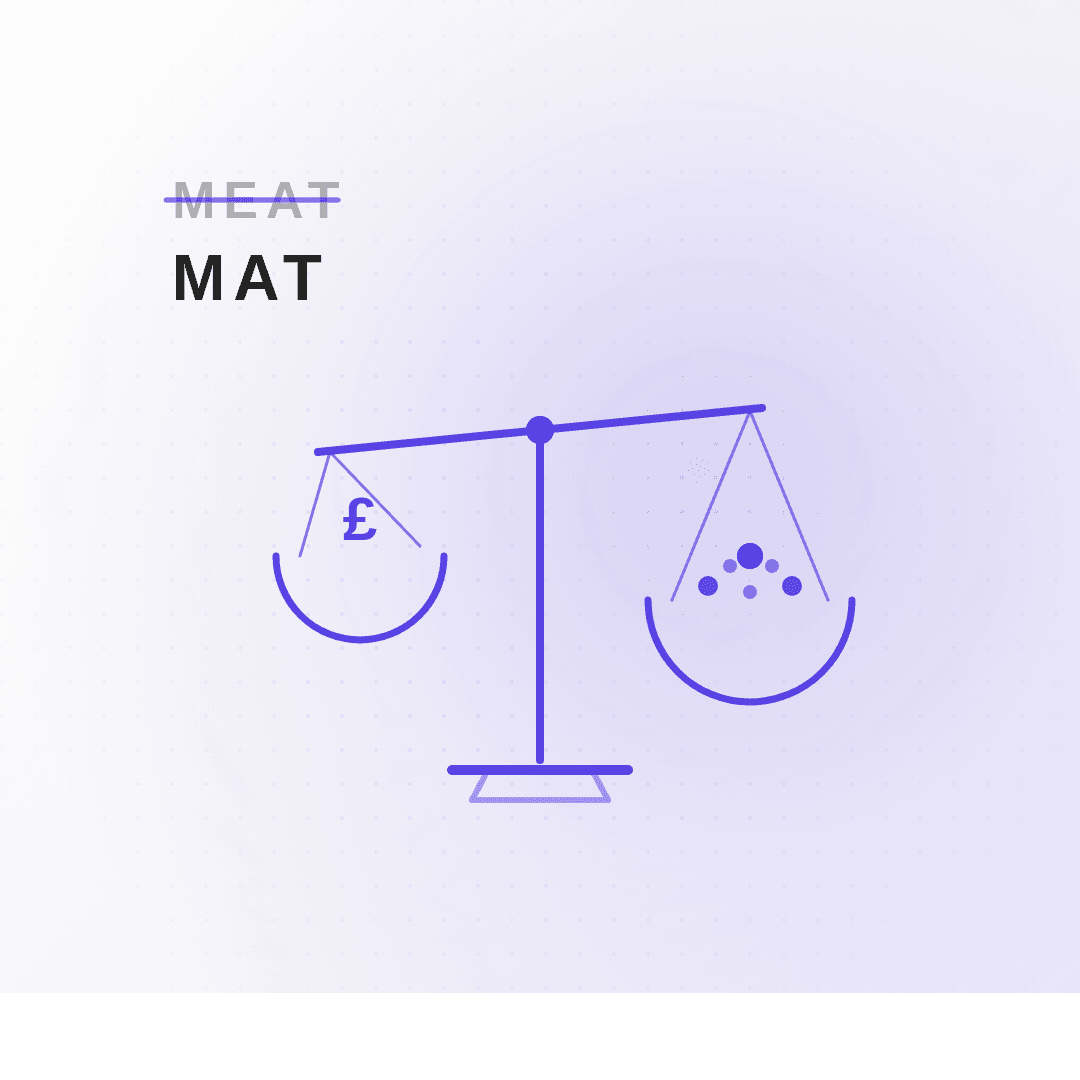
The Procurement Act 2023, which came into force on 24 February 2025, replaced "most economically advantageous tender" (MEAT) with "most advantageous tender" (MAT) as the standard for awarding UK public contracts. Dropping the word "economically" is not a rebrand: it removes the assumption that price must lead, and gives contracting authorities explicit room to weight social value, environmental impact, innovation and wider public benefit alongside cost and quality. Procurement Act 2023, Section 19
If you bid for public sector contracts, this is the most significant change to how your tenders are scored since the Public Contracts Regulations 2015.
24 February 2025
GOV.UK
What MEAT meant under the old rules
Under the Public Contracts Regulations 2015 (PCR 2015), public contracts had to be awarded to the supplier submitting the most economically advantageous tender. That word "economically" did real work: it anchored evaluation in financial criteria. Quality, social value and technical merit could count, but price was structurally dominant, and awarding on lowest price alone was legally permissible and common on simpler, lower-value contracts.
In practice that produced a procurement culture that too often rewarded the cheapest bid over the best one. A well-resourced supplier could undercut on price, win the work, and deliver a mediocre service, and the system had limited tools to penalise that pattern.
What changed: MAT under the Procurement Act 2023
Section 19 of the Procurement Act 2023 now requires contracting authorities to award public contracts to the supplier that submits the most advantageous tender, with "economically" removed. The Act defines the MAT as the tender that, in the authority's view, satisfies its requirements and best satisfies the award criteria when assessed by reference to the published assessment methodology and the relative importance of the criteria. Procurement Act 2023, Section 19
Critically, Section 12 also requires authorities to have regard to four procurement objectives throughout any covered procurement:
- Delivering value for money
- Maximising public benefit
- Sharing information so suppliers and others can understand the authority's decisions
- Acting, and being seen to act, with integrity
The phrase "maximising public benefit" is the load-bearing change. Where the Public Services (Social Value) Act 2012 only asked authorities to "consider" social value, Section 12 sets a higher legal standard, creating a statutory duty to look beyond the bottom line. Procurement Act 2023, Section 12
“Price still matters. What MAT removes is the obligation for price to be the thing that decides.”
MEAT vs MAT: the key differences
| Feature | MEAT (PCR 2015) | MAT (Procurement Act 2023) |
|---|---|---|
| Legislative basis | Public Contracts Regulations 2015 | Procurement Act 2023 (s.19, s.23) |
| Came into force | 2015 | 24 February 2025 |
| Primary driver | Economic and cost efficiency | Broadest public advantage |
| Price | Mandatory factor; could be the sole criterion | Still important, but not structurally dominant |
| Social value | Encouraged (PPN 06/20) | Minimum 10% weighting for central government (PPN 002) |
| Environmental criteria | Permissible | Explicitly encouraged; tied to the National Procurement Policy Statement |
| Innovation | Permissible | Explicitly valued |
| SME access | Considered | Authorities must have regard to barriers facing SMEs |
| Award on lowest price alone | Legally possible | Permitted, but guidance says it is unlikely to suit most contracts |
| Transparency of criteria | Required | Required, plus assessment summaries for unsuccessful bidders |
What MAT means in practice: the three pillars
### Social value, now weighted
Procurement Policy Note 002 (PPN 002) requires a minimum 10% weighting for social value in tender evaluations for in-scope central government organisations, that is departments, executive agencies and non-departmental public bodies. The revised Social Value Model, structured around the government's national missions, became mandatory for in-scope procurements from 1 October 2025, and authorities are free to weight social value higher where the market can bear it. PPN 002, Cabinet Office
10%
Cabinet Office
What that means concretely: a supplier who can evidence local job creation, apprenticeships, supply chain diversity and a credible carbon plan is now competing on different ground than one that can only offer the lowest day rate.
### Environmental and sustainability criteria
MAT lets authorities weight environmental criteria, including carbon reduction and net zero commitments, circular economy practices, waste minimisation, clean energy use and biodiversity. Section 12's "maximising public benefit" duty pulls these from the periphery into the mainstream of evaluation.
### Innovation and quality
The MAT framework is deliberately less prescriptive than MEAT, giving buyers more room to reward innovative approaches, long-term outcomes and a supplier's delivery track record, rather than the cheapest methodology document.
How buyers are weighting value now
The headline figure is a floor, not a ceiling. PPN 002 sets a 10% minimum for central government, but in local government and the wider public sector, weightings already run higher, and social value is increasingly the criterion that separates close bids.
| Buyer or scope | Social value weighting | Source |
|---|---|---|
| In-scope central government, above threshold | Minimum 10% | PPN 002 |
| Manchester City Council | 20% social value, plus 10% environmental | Manchester City Council |
| Common practice across the sector | Around 20% | Social Value Portal |
These commitments are not just scored, they are increasingly contractualised. Before entering a public contract worth more than £5 million, an authority must generally set at least three key performance indicators and publish them, so a social value promise made in a bid can become a measured contract obligation. Procurement Act 2023, Section 52
£5m
Procurement Act 2023, s.52
What hasn't changed
It is worth being clear about what the government's own guidance says: MAT is a clarification, not a policy change. The Cabinet Office guidance on assessing competitive tenders states that the move from MEAT to MAT "is not a change in policy" and is meant to "clarify and reinforce for contracting authorities that tenders do not have to be awarded on the basis of lowest price/cost". Assessing competitive tenders, Cabinet Office
Price is still important. Budgets are real. Value for money remains a Section 12 objective. What MAT does is give legal backing to the broader definition of value that progressive buyers were already trying to apply. Awarding on lowest price alone is still technically possible where price is the sole award criterion, but the guidance says this is unlikely to suit most contracts, and an authority must weigh its other duties first.
The rule that award criteria must relate to the subject matter of the contract also stays in force under Section 23. You cannot bolt on arbitrary social value criteria with no connection to what is being bought. Procurement Act 2023, Section 23
What this means for suppliers
If you have struggled to compete on price against larger incumbents, MAT opens new ground. Buyers now have explicit legal backing to weight your local presence, sustainability credentials, workforce and innovation, provided those criteria are proportionate and relevant to the contract. For SMEs in particular, the Act requires authorities to have regard to the barriers smaller suppliers face, not merely to note them.
Three practical implications:
- Read the evaluation methodology as a roadmap. Under MAT, buyers must publish their award criteria and weightings up front. If social value is weighted at 20%, resource your response to match, rather than treating it as an afterthought.
- Make social value commitments specific and measurable. Vague lines about "supporting local communities" score poorly. Time-bound commitments, such as two full-time apprenticeships within twelve months of contract start, score well and are increasingly written into KPIs.
- Price transparently. MAT rewards value-based pricing, not the cheapest possible bid. A suspiciously low price can be scrutinised, and ultimately disregarded, as an abnormally low tender under Section 19, but only after you have had a fair chance to justify it.
The regulatory architecture around MAT
| Instrument | Role |
|---|---|
| Procurement Act 2023 | Primary legislation: s.12 objectives, s.19 MAT award and abnormally low tenders, s.23 award criteria, s.24 refining criteria, s.52 KPIs |
| National Procurement Policy Statement | Statutory strategic priorities that authorities must have regard to |
| PPN 002 | The central government Social Value Model and the minimum 10% weighting |
| PPN 003 | Embeds social value across the procurement lifecycle, including frameworks and call-offs |
| Sourcing Playbook | Best-practice guidance, including price per quality point methodology |
| Procurement Review Unit | Oversight body that can investigate non-compliant procurement |
FAQ
Does MAT mean price no longer matters?
No. Price remains a mandatory consideration under the value-for-money objective in Section 12. What MAT removes is the obligation for price to be structurally dominant. A buyer can weight quality or social value more heavily than cost where that is proportionate to the contract.
Can a contracting authority still award on lowest price alone?
Technically yes, where price is the sole award criterion. But the government's own guidance says this is unlikely to suit most contracts, and an authority must first weigh its other duties, including value for money and maximising public benefit, both of which are usually broader than cost.
Does MAT apply to all public contracts?
MAT applies to contracts within scope of the Procurement Act 2023, that is above-threshold contracts let by contracting authorities in England, Wales and Northern Ireland. Scotland has its own procurement regime. Below-threshold contracts have lighter requirements but are still published on the Central Digital Platform.
What is PPN 002 and who does it apply to?
PPN 002 sets the central government Social Value Model and mandates a minimum 10% social value weighting in tender evaluations. It applies to central government departments, executive agencies and non-departmental public bodies. Local authorities and NHS trusts are not bound by it, but many follow it and exceed the 10% floor.
When did MAT take effect?
MAT took effect on 24 February 2025, when the Procurement Act 2023 came into force. A procurement commenced before that date continues under PCR 2015 rules for its full lifecycle.
Does MAT change how frameworks work?
The core mechanics remain, but the Act introduces open frameworks that can be reopened at set intervals, and PPN 003 requires social value to be embedded at both framework establishment and call-off.
Is the 10% social value weighting a minimum or a fixed number?
It is a minimum for in-scope central government bodies. Local authorities and other public bodies have flexibility, and many already apply 20% or more. Where the market is mature, buyers are encouraged to go above 10%.
What happens if a supplier wins on social value promises but does not deliver?
For contracts over £5 million, KPIs must be set, published and assessed at least annually under the Act, so social value commitments can be monitored. The discretionary exclusion grounds have also been widened to capture poor performance history.
Sources
- Procurement Act 2023, legislation.gov.uk — Sections 12, 19, 23, 24, 52
- Guidance: assessing competitive tenders, Cabinet Office
- PPN 002: taking account of social value in the award of central government contracts
- The Procurement Act 2023 and social value, Social Value Portal
- MAT: the new MEAT, Gowling WLG
Download the full report
Submit the form below to access the full report.
Want this analysis run on your own pipeline?
Start for free and run your real opportunities through Skim — see what the data says about your win chances.